Saturday, September 13, 2014

Christmas Really?


Last night DH and I drove over to Pittsburg State University to attend the first of this year’s Visiting Author series. We used to never miss and then life intervened. Last year we managed to miss every single speaker. We have slipped into a type of evening lethargy here and DH was wise to push us out for this reading by Thomas Fox Averill.

Averill is on staff at Washburn U in Topeka, Kansas, and he has authored several books. His last was rode , a novel he constructed around a favorite song of his, “Tennessee Stud”. It was a great read and is fascinating how the author found his inspiration for a great read from a song.

When I got news Fox was to read from his new book, a carol dickens christmas (Fox must have an aversion to capitals!) I was disappointed in his subject. It seems every established author hammers out a Christmas book to garner up holiday profits for a publishing house. Also, how many times can writers play with the work of Charles Dickens?

The first thing the author told the audience was he worked on the book for ten years. He explained how he researched by going even to England to experience Dickens home and writing life. The book includes Victorian recipes that he personally tested at home. He set the modern day story of Carol Dickens and her life in Topeka, Kansas, a town he knew well.

Averill then began to read pages and introduce characters. I found some I liked. I still felt the Christmas theme might be overworked, but I am interested in Kansas settings so I listened hard. I stumped Averill after his reading when I asked how the story of Carol Dickens might have been different in another geographical area…what made part of the story was totally regional? He said good question and then segued into a lot of Kansas writers are capturing the region and suggested I visited his web site listing them. (http://www.washburn.edu/reference/cks/mapping/index.html) 


Okay, I suckered right up and bought the book. I think it will be a pleasant read if nothing else, but I am not going to read it until closer to the holidays…an early present to myself.  I’ll let you know how the book reads then, but I bet I'm not disappointed since it is by Thomas Fox Averill. 

Thursday, September 11, 2014

Ernie Pyle Again


The men are walking. They are fifty feet apart, for dispersal. Their walk is slow, for they are dead weary as you can tell even when looking at them from behind. Every line and sag of their bodies speak their inhuman exhaustion.

On their shoulders and back they carry heavy steel tripods, machine-gun barrels, leaden boxes of ammunition. Their feet seem to sink into the ground from the overload they are bearing.

They don’t slouch. It is the terrible deliberation of each step that spells out their appalling tiredness. Their faces are black and unshaven. They are young men, but the grime and whiskers and exhaustion make them look middle-aged.   May 1, 1943


I knew the power and precision of Ernie Pyle’s writing, but I wanted to know the man himself. So I picked up a copy of Ernie Pyle’s War: America’s Eyewitness of World War II by James. Tobin. The author takes  readers back to the beginning in Dana, Indiana and shows how an only child grew up in a farming family. Pyle was an undersized but bright student who could not wait to make his way out into the world away from the Midwest.

Pyle was an excellent journalist, one worthy of studying. He began with reporting, then an aviation column (during the early years when planes were the new technology), and then a roving column of human interest stories in roadside spots of America. He gradually became popular, the number of readers growing during the era of Hearst, Scripps-Howard and other big newspaper chains. Eventually, he became the world’s greatest war correspondent during World War II.

Pyle did not write of policy or generals; he wrote of the common soldier, the common man. He made readers see what he saw. Indeed, the author’s ability with words recreated everything for readers that he saw with his own eyes. His writing allowed readers to view the war in a time when newsprint was the way media got stories out. He became so popular among his favorite subject the infantrymen and the reading public that he developed a mythological aura. Eventually a movie, Ernie Pyle’s American G. I. Joe, was made from his work. Starring Burgess Meredith and Robert Mitchum, the dated film can be seen on U-Tube.

While Pyle was developing a star persona, producing extraordinary copy from fox holes, and setting a standard for other writers, his personal life was somewhat a shambles. A slightly built man of ordinary looks, he suffered health problems, drank too much, and dealt with a rocky marriage to a woman of mental instability. Like many creative people, he doubted his own work many times feeling he was not writing quality copy.

This is an extraordinary book published 17 years ago and 69 years after Pyle’s death on a Pacific Island covering the war. It reveals the weaknesses and travails of an ordinary man; it shows the power of a great writer; it takes readers through the war that should never be forgotten.

            “I love the infantry because they are the underdogs. They are the mud-rain-frost-and wind boys. They have no comforts, and they even learn to live without the necessities. And in the end they are the guys that wars can’t be won without.”

                                                                          Ernie Pyle

Tuesday, September 9, 2014

More Indoor Weeding At This House!!!


Books are a hindrance to persisting stupidity…Spanish proverb


Weeding continues here. Once the attic was done, it felt so good I wanted to keep going. So midmorning I started on the bookcase in my office. Oh my, where to begin? How could I turn loose of any one of them?

But begin I did. None were bad books, but they were just less worth the room they took than other favorites. A lot of poetry books were removed, but a whole basket remain. I pulled some novels…some children’s books…a few reference type books I used in the classroom. Some I set aside to look at one more time before letting go.

I took my books to the public library where some will be shelved and some will be put on their resale shelves as fund raising for the library. I hurried them right down this afternoon before any could just back out of the boxes!

And before I look too saintly, I must confess to making an order last night to Lou Turner and her High Hill Press.

J

Sunday, September 7, 2014

A Perfect Sunday


Friday’s rain was a welcome relief to both drought and heat since the front also brought cooler temps too. So yesterday morning we faced cleaning the attic over the garage. DH had been begging me to “release” some of the thing stored there. Frankly, I reminded him that he had two buildings on the property full of “stuff”, but he assured me all that was of vital importance!

So we dragged down toys, high chairs, baby bed, boxes of fruit jars, old suitcases, saved carpet pieces, wall paper rolls, paint buckets, movie projectors and more. I know most was not worth money, but the items were loaded with memories. I have diminished the stash periodically over the years, but now it was time to relinquish it all. I shut my eyes and did it.

We have buried four people in the last seven months. We have helped move a household, helped another settle downsize a widow’s home, and all this after closing a farm house only months ago and also watching people lose every stick of their possessions in a tornado. How does one walk away from all these life items? But I thought about how it felt to rummage in the ashes of my mom’s burned house trying to figure out what had been what and where. I thought of my own children going through an attic of things wondering WHY we never turned loose of things.

I weed the house routinely, but still closets are full. I know I must dig deeper and release more. But yesterday we dug deep into the attic. Only half the fruit jars and the baby bed remain. The trash men are going to gasp when they arrive in the morning. I gave in on everything but the baby bed. Alas, it too will go but when and how? No one wants it, but when I look at the bed I see my parents as young marrieds with no money, but they sweat out pennies to buy this brand new baby bed for a brand new baby. It was a small fortune for them as it was large enough to use as a youth bed as well as for a new born. Three daughters slept in that bed; two grandsons grew in that bed. But no one wants it now…it is sad to me.


After a long and dirty day yesterday, I got up to a beautiful morning. Dog and I bundled in flannel robe and made sure we had a heavy cozy for the tea pot as it was 55 chilly degrees on the deck. The air was also damp enough my book pages began to go limp. But book and reader hung in there, not sparing a minute of morning's beauty. Eventually breakfast of bacon, eggs, toast and jam increased the joy of morning. The skies are now a shade of sapphire dotted with an occasional splat of cottony cloud and makes for a perfect reading day. Tomorrow we can work again, but today it is book and tea time all day long outside! 

Saturday, August 30, 2014

Labor Day Closures


It is Labor Day Weekend and that means things are beginning to change to oranges and burgundy shades now. When I was a child, it meant end of summer and beginning of school. Now school starts much earlier. DH and I rarely travel on this busy holiday, but hunker close to home feeling the change in seasons as if it were a mantle laid over our shoulders. It is still warm out, in fact, it is hot and steamy. The sky has haziness to it, like a layer of summer dirt has rested over the sun waiting for a clean wash from autumnal rains.


After 30 years, our garage door opener gave out so DH has been replacing both sides. It has been slow due to health and heat.  But today it is done and now clean up begins. While buying the openers, I saw a clearance sale on fountains. I have had a wooden one DH made on the deck. It was nothing pretty…just all we have had for years. Now I have a real one, a small waterfall really. I love sitting there with my tea pot early in the mornings listening to the water dance across the rocks. I can shut my eyes and be by any stream I have or have not seen in my lifetime…and all without worrying about a bear biting my behind!


Thanks to Martha at Lines from Linderhof (http://www.lflinderhof.com/) our lunch was a Shady Gables chicken salad and tomato spice bread. Shady Gables is a wonderful English tea room in Missouri that we once visited, and the salad has both apple and onion in it. The tomato bread is a lovely autumnal crimson shade made from end of the season tomatoes. Email me if you would like the recipes.

Happy Labor Day to all my readers!


Monday, August 25, 2014

August Is Passing!


This morning I noticed how dark it was at 6 a.m. It felt like the middle of the night instead of a time for dawn. I read in my chair a while before starting the kettle. Then Miss Biscuit and I took our tea tray outside where it was so obviously a late week in August.  The wrens were gone; the hummers had begun to migrate and hit the disappointment of red geraniums before moving on; the verbenas had yellow leaves and marigolds were drying up. The crickets were singing, reminding us that autumn was coming. Spiders were spinning webs from deck posts to flower pots.  The summer was passing right before my eyes.

While early mornings whisper autumn, a few hours later summer’s force lets us know he hasn’t gone yet. Temperatures are so hot that breathing is a challenge. Sweat pours off our skins with any exertion. Lunch is no longer pleasant on the deck so we retreat to the kitchen for cool salads using the last of the tomatoes. Afternoon means a “sit down” in recliners with books.  Evenings might be (boring) television because the air still burns the skin, and then there are the “no seeums” which blister my bare legs and ankles being a high price to be outside at dusk.

This afternoon I looked through a book that did not live up to my expectations. Consider the Fork: a History of How We Cook and Eat by Bee Wilson is packed full of facts, but something about the presentation left me uninspired. The one chapter on spoons was more interesting than most. There was quite a variety of spoons such as bone or pearl spoons for eating soft boiled eggs since egg yolk tarnished silver. There was also some info on silver marrow spoons. The 18th century Georgians had a fondness for bone marrow and a special spoon for digging it out was useful. But the most interesting was the development of the teaspoon in the 17th century when the English began adding milk and sugar to their tea cups. The teaspoon moved from being just for tea service to the dining table.


The summer has slipped by fast. After winter woes and spring situations, summer has been loaded with issues too. September looks inviting at the moment. I can hope that this year will end with some good things maybe. I am ready for cooler air….some writing….some walks…some pleasant moments outside other than just morning tea. I pulled my Cranberry Autumn tea out this morning, but I thought, “No, not yet. It will be savored more in a week or two when real autumn arrives.”

Sunday, August 17, 2014

Please Meet Ernie Pyle


When I started teaching writing lab, I had never heard of Ernie Pyle. I had done a lot of WWII reading, and I was familiar with Bill Mauldin who drew famous cartoons and Andy Rooney who reported for newspapers during the war. So I was pleasantly surprised when our textbook had us study Ernie Pyle for writing clear details. My students knew little about WWII and thought war was some glorious Rambo romp. So I was thrilled to see them learn writing but also take a realistic look at war through this journalist’s eyes.

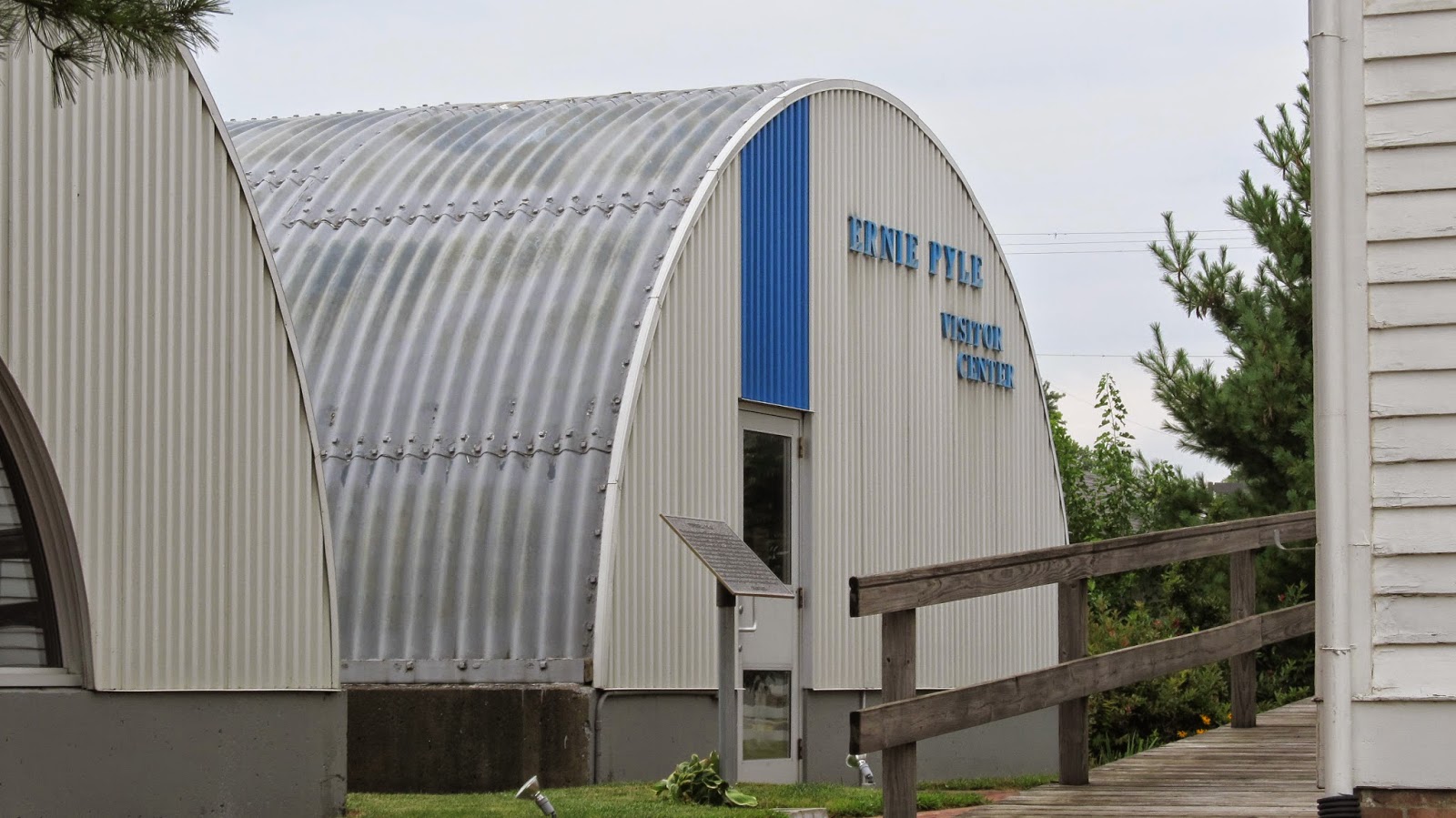
Pyle grew up in the flatlands of Middle America among the corn fields of Indiana. Last fall as we drove to Kentucky, I caught sight of a small sign near Dana, Indiana that mentioned Ernie Pyle’s home. I had DH put on the brakes! Dana itself was only a spot in the road surrounded by an ocean of corn. But there was a beautiful white house next to two Quonset huts serving as a museum. Unfortunately they were closed. But this month on a return to Kentucky, we routed ourselves right by Dana again to visit the Ernie Pyle Home and Museum.


Ernie Pyle was an only child. The home was moved into town from the farm where he grew up. It is reminiscent of all homes of the 1920 or so era. His mother pushed Ernie to get an education, and after graduating from college, Ernie went to work as a newspaper reporter. The rest is history. He never intended to cover war, but the work swallowed him and became his life for a few years. His approach was slightly different. He looked for the untold details, for the aftermath and suffering to humans that war cost. He was on the beach after the invasion of Normandy and painted pictures for readers not of gunfire or dead bodies but of letters from a mom covered in sand, an open Bible marked with favorite verses, a cigarette lighter, a dog lost and looking for the man he knew….heartbreaking details that moved readers beyond belief.


He never was a soldier but he lived a soldier’s life right with the armies. He was with infantry troops and lived their own rugged life. Pyle covered all of the war and wanted to quit, but one last venue remained. He had not covered the Pacific and there were still Americans fighting on islands. He wanted to give them coverage too. So he went. It was there that 44 year old Ernie Pyle was shot down and died.


                     Imagine a small boy doing his homework here while his mother peeled  apples or 
             canned corn. The kitchen was the center of activity for the Depression era homes.


Depression Era bedroom in the Pyle farm home. Note the quilt. Each block is a signed one. People paid a quarter to sign a block and then the church ladies quilted it and put the quilt up for raffle. They made $200 which was a load of money at the time. 


In Dana, Indiana you can tour his childhood home. The two Quonset huts are a delightful museum of his war life. There are constant running sound effects that one would have heard if they had stood in Pyle’s shoes during WWII. The sound of fighter pilots, bombers, exploding firepower, and grenades going off are not gruesome but so amazingly authentic that it adds to the museum experience. This museum is a tribute to a journalist, but also to a war hero too. It is so worth your time to visit here, and although it once was a state site, now it is run by the Friends of Ernie Pyle. They struggle to keep the doors open, but honoring a hero is always a good thing. We need more of them to look up to and to remember.


DH is never surprised anymore when I drag him off the beaten path. This time he thought “just another writer” site. But when the car pulled away he told me he was SO glad he saw this place and learned about Ernie Pyle. I definitely will be reading more about Pyle’s life, and I bet DH will too!